
An Anatomy of a Genocide: The Gaza Case
The events in Gaza since October 2023 are more than the tragic consequences of war; they are part of a holistic strategy to eliminate the material and spiritual existence of a nation and group of people. This study examines this systematic campaign in all its dimensions.
ARTICLES & REPORTS
Dr. Bilal BİLGİLİ
10/18/2025
AN ANATOMY OF A GENOCIDE: THE GAZA CASE
The events in the Gaza Strip since October 2023 present a picture of destruction and humanitarian collapse, of which many examples have been seen in the history of war, but this one is being carried out live before the eyes of the whole world. Furthermore, it is unique in that it has turned into a process in which states and their administrators remain indifferent, play the three monkeys, and even erode and suppress all the gains of modern society such as human rights and freedom of expression, despite widespread social movements all over the world.
Israel's campaign in Palestine, which began in October 2023 -a process that did not begin in October 2023- is not an ordinary military conflict, but a multi-layered campaign of annihilation targeting the existential foundations of a people. The reports that form the basis of this analysis and the author's article in Al Araby newspaper reveal the systematic structure and devastating consequences of this process[1]. When the findings of these reports, which are shocking even independently, are brought together, they complete a larger and darker picture: while some reports offer a quantitative autopsy of how the physical, economic, and social structure of the society was collapsed; other reports provide a qualitative analysis through concrete elements and actions of how the soul, collective memory, identity, and intellectual future of that society are being deliberately erased.
This text aims to analyze the acts of destruction, massacre, and genocide in Gaza from a holistic perspective, based on the findings in the said reports and open sources. Accordingly, it is concretely seen that what is happening is not a series of military operations for security purposes, but part of a deliberate and holistic strategy to eliminate the material and spiritual existence of the Palestinian people in Gaza. This strategy will be discussed within the legal and rhetorical frameworks that legitimize the destruction of economic and social life, the annihilation of cultural and intellectual existence, and these actions.
The Destruction of Living Space: The Strategic Meaning of Economic and Social Collapse
The scale of the destruction in Gaza has transformed it from an operation against military targets into a strategy to make a geography completely uninhabitable. The data presented in the CHS report proves how systematically the economic and social pillars of this strategy have been implemented. The aim is not only to win a military victory but also to eliminate the idea and possibility of a "homeland" to return to after the war.
- The Deliberate Termination of Economic Life
A society's economic independence and productivity are crucial for its survival. This is precisely what has been targeted in Gaza. The infrastructure damage, reaching approximately $49 billion as of February 2025, shows the financial dimension of this strategy. Behind this figure lies a concrete reality, more than 80% of industrial and commercial facilities have been rendered unusable, 93% of bank branches have been destroyed, and the Gross Domestic Product has fallen below 25% of its pre-war level. Unemployment has risen to 78% and poverty to 85%. This is not an economic collapse caused by war, but an operation to economically strangle a society. Those who can receive their salaries get less than half, but the worn-out banknotes they receive are rejected by shops. The fact that they are unable to meet even the simplest necessities of life reveals a humanitarian dimension of the situation. To break the resistance of a people, they have been made permanently dependent on poverty and foreign aid.
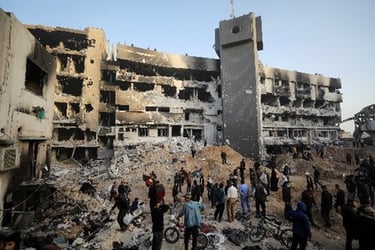
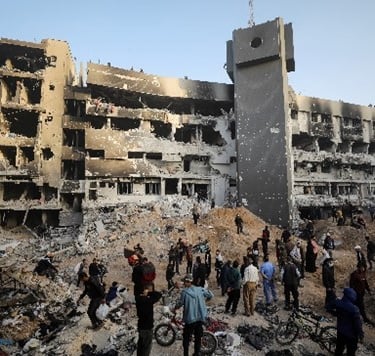
Figure 1: A photograph showing the scale of destruction in Gaza (Left). Shifa Hospital (right), Israel had claimed there were tunnels beneath the hospital belonging to Hamas.
- The Destruction of Social Resilience
A society can survive with structural components such as education, health, communication, transportation, justice, and social protection mechanisms. In Gaza, all structural supports for society have been systematically targeted over the past two years. The health system is one of the main areas at the center of the attacks. The disabling of 27 hospitals and 57 health centers, the destruction of more than 120 ambulances, and the killing of over 1,400 health personnel mean that the wounded and sick are left to die. In the words of Dr. Madeline Abu Asr, Head of the Emergency Department at Al-Ahli Baptist Hospital, there is a “decline in providing health services, an increase in mortality rates, and an inability to treat chronic diseases”. Attacks on health facilities -though prohibited by international humanitarian law- are not just an attack on infrastructure, but deliberate attacks on the most basic life security of society.
Similarly, the destruction of more than 90% of the courthouse buildings has left the social order and individuals mechanisms for seeking justice under the rubble. These actions aim to leave a society defenseless not only physically but also institutionally and psychologically. Indeed, reports document that 70% of the population experiences high levels of anxiety and depression, and 45% of children show symptoms of post-traumatic stress disorder.
The Destruction of Memory and the Future: The Logic of Cultural Genocide
The prepared reports illuminate the darkest and perhaps most permanent aspect of the war in Gaza. This war targets not only the present but also the past and the future. This is a cultural genocide that reveals the intention to eliminate a group's identity and right to exist, which is one of the most prominent features of genocide. To destroy a people is not only to kill its people but also to erase everything that tells who they are, where they come from, and where they are going.
- The Killing of a Generation's Future (Scholasticide)
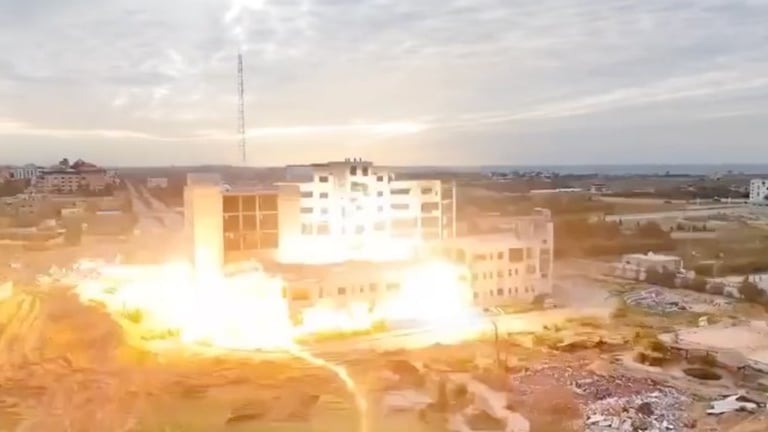
The bombing of all -without exception- universities in Gaza and their demolition with controlled, precise attacks cannot be a random choice of target[2]. This is an act of scholasticide - the deliberate destruction of a society's intellectual future, scientific capacity, and potential to rebuild itself. When the physical destruction is considered together with the killing of more than 100 academics, including the world-renowned scientist and university rector Sofyan Taya and the poet and academician Refaat Alareer, and over 150 cultural figures, the integrity of the strategy is better seen; it is better understood that the ultimate goal of the strategy is not only to destroy buildings but also to destroy the brains that give spirit to Palestine and its society. Evidence that Palestinian intellectuals received death threats from Israeli sources before being killed shows that these murders were not accidental, but that the intellectual leadership was deliberately targeted.
Figure 2: Al-Israa University during the destruction.
- The Uprooting of History and the Erasure of Memory
A people's existence depends on its historical continuity and cultural heritage. The destruction of the Gaza City Archives, along with 150 years of documents, is an attempt to erase the city's land records, memory, and past[3]. The destruction of libraries -especially the Edward Said Public Library, Gaza's first English library- is the destruction of the intellectual bridges that Gazans had built with the world, for a society that had been restricted, besieged, and isolated for years. This destruction was expressed by the library's founder, Mosab Abu Toha, with the sentence, “all the dreams we drew for our children were burned by Israel's genocidal campaign.”
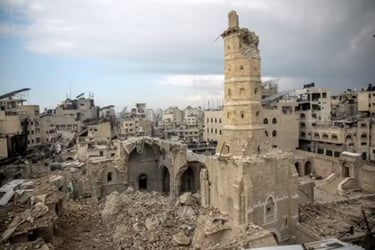
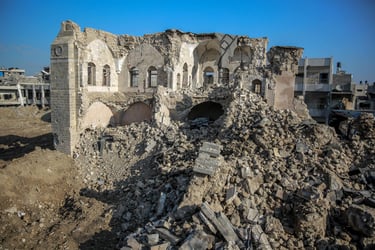
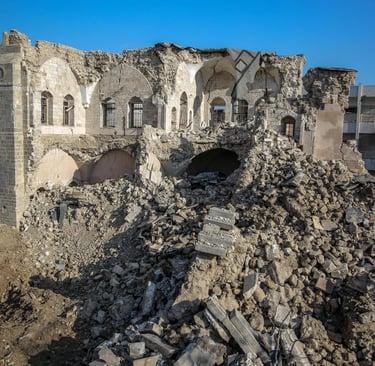
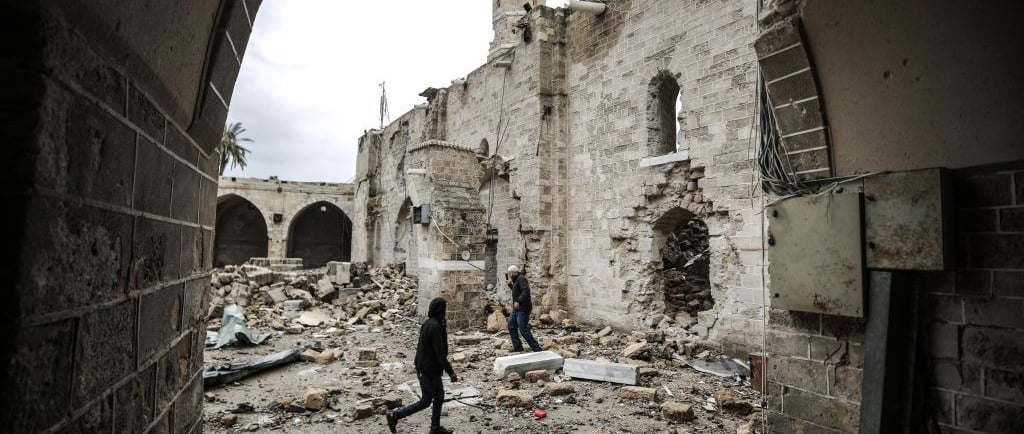
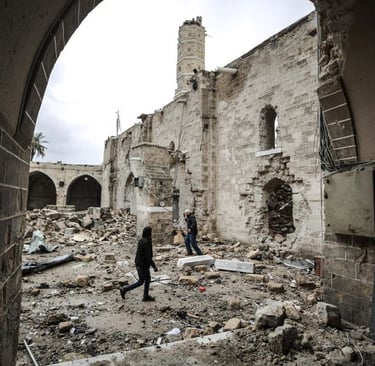
The destruction of archaeological sites such as the 7th-century Great Omari Mosque, Gaza's oldest church, the Church of Saint Porphyrius, museums, the 750-year-old Hamam al-Samra, and the Port of Anthedon is part of an effort to deny the Palestinian people's thousands of years of roots in that land and to leave them without a history[4]. Videos of Israeli soldiers burning books in libraries and the Quran in mosques reveal not just the military logic behind this destruction, but also the cultural hatred and humiliation[5].
Figure 3: The Great Omari Mosque (Left), Pasha's Palace (Right).
As can be understood from the paragraph above, the systematic destruction and genocide witnessed in Gaza are being carried out together with a memoricide. Israel's extermination operations have also revealed a dark paradox of the digital age-in the context of memoricide. In an era where the possibilities of instant witnessing and documentation are at their peak, the threat of the traces of a genocide being transmitted to the future either distorted or completely erased has never been so concrete. The deliberate killing of journalists on the ground, the destruction of communication infrastructure, and the blockade imposed on international media are the main strategies of this erasure operation[6]. This also means covering up the crime by destroying its evidence and making future accountability impossible[7].
Legal Conclusion: Systematic Acts, Clear Intent, and the Crime of Genocide
From a legal perspective, the evidence in the reports and open sources strongly suggests that Israel's actions meet the elements of the definition of genocide, which is considered the gravest crime in international law. This is not just the sum of a series of war crimes, but a more holistic and deliberate project of extermination.
- From Crimes Against Humanity to Genocide War Crimes
The systematic targeting and killing of civilians; the direct and systematic targeting of hospitals, schools, cultural properties, and residences (contrary to the 1954 Hague Convention) constitute widespread war crimes[8]. The use of wide-impact explosives, such as 2,000-pound bombs, in densely populated areas is a clear violation of the principle of distinction in International Humanitarian Law. The commission of these acts "as part of a widespread and systematic attack" also places them in the category of crimes against humanity. However, what makes the situation in Gaza different is the clarity of the greater intent behind these actions.
- Elements of the Crime of Genocide: Acts and Intent
Proving the crime of genocide requires demonstrating that specific acts were committed with the intent to destroy a group. Publications, images, videos, and international reports on the acts committed in Gaza over the past two years provide overwhelming evidence for both elements (acts and intent). Furthermore, it is an unconditional necessity for impartial experts to conduct on-site observation and assessment as soon as possible for the prosecution and punishment of those responsible for this process. These elements are as follows:
Acts: In addition to mass civilian deaths, one of the most critical articles of the Convention on the Prevention and Punishment of the Crime of Genocide, the act of “deliberately inflicting on the group conditions of life calculated to bring about its physical destruction in whole or in part,” has been implemented as a continuous and powerful strategy in Gaza. The systematic starvation policy is the most concrete proof of this. Making agricultural lands unusable, bombing bakeries, kitchens, and food distribution points, and killing civilians waiting for aid show that famine and starvation in Gaza are a designed policy and a weapon of extermination.
Intent: The "intent to destroy," the most challenging element in proving the crime of genocide, is revealed by the statements of Israeli officials themselves. Prime Minister Netanyahu's promise to turn Gaza into “cities of ruins,” Defense Minister Yoav Gallant's statement that “all restraints have been removed” and that he ordered to “attack everything,” and President Isaac Herzog's claim that “an entire nation is responsible” in Gaza and that civilians are not innocent, are confessions that reveal the mentality and political purpose behind the actions on the ground. On the other hand, the targeting of a group's cultural heritage can be evidence of the perpetrator's intent to destroy that group. The systematic erasure of universities, libraries, archives, and historical monuments shows the intent not only to destroy buildings but also the collective identity, memory, and historical continuity of the Palestinian people.
These findings are also consistent with international legal and academic assessments, such as the International Court of Justice's provisional measures order finding a “plausible risk of genocide” in Gaza and the International Association of Genocide Scholars' decision, by an overwhelming majority, that Israel's actions meet the legal definition of genocide.
Conclusion
Reports from international organizations, written, visual, and video posts on social media accounts since October 2023, and witness testimonies reveal a part of the anatomy of what is happening in Gaza. Publicly available documents -and on-site observations will more strongly support the extent of the atrocity- reveal the quantitative data of the physical death of Gazans, as well as the painful qualitative story of how the soul, memory, and identity of the society are being killed. This picture is not a war waged against a specific enemy, but a war waged against the existence of a society.
What is happening live in Gaza before the eyes of the world is not merely the foreseeable and understandable tragic consequences of a war. On the contrary, it is a systematic campaign aimed at the total annihilation of a people. The destruction of economic life, the fragmentation of the social fabric, the collapse of the health and justice systems, the erasure of historical and cultural heritage, and the darkening of the intellectual future are all parts of a holistic strategy serving a single purpose.
When the evidence is evaluated holistically, it is inevitable to conclude that the ultimate goal of the slaughter in Gaza is not just to leave behind a defeated people, but also to leave behind a cleansed geography. This is a project to create a void where a people, its history, its culture, and its future do not exist, and Israel has been systematically carrying this out for decades. This situation is an existential challenge not only for the Palestinian people in Gaza but also for the future of international law, humanitarian values, and the global conscience.
The events in Gaza have gone down in history as one of the most severe humanitarian and moral crises of the 21st century, involving the gravest violations of international law. It creates a responsibility for international institutions and the community to urgently operate the mechanisms of justice and accountability.
Notes
[1] The analysis was conducted based on numerous international reports, particularly “The Gaza Strip Amidst Genocide and Displacement” published by the Center for Conflict and Humanitarian Studies (CHS), “All That Is Lost: The Cultural Destruction of Gaza” prepared by PEN America, “Destruction of Gaza’s Cultural Heritage” prepared by Hamdan Taha, as well as reports from the World Bank, the European Union, and the United Nations, in addition to open sources and social media posts. The article titled “Reshaping the Narrative... Urbicide and Cultural Genocide in Gaza,” prepared by Bilal Bilgili and May Barakat, argues within a historical context that Israel's destruction in Gaza is not merely a physical attack but also a conscious strategy of urbicide and cultural genocide aimed at eliminating the collective memory, identity, and historical connection of the Palestinians.
[2] Al-Israa University, which was the last standing institution of higher education, was used as a base by Israeli forces for 70 days and was destroyed in a controlled explosion in January 2024. The university also housed a national museum with more than 3,000 rare archaeological artifacts. After months of airstrikes, the buildings of Al-Azhar University were deliberately detonated by Israeli soldiers in December 2023 after they took control of it. The Islamic University of Gaza was hit by an airstrike on October 9, 2023, causing major damage to its technology and science faculties.
[3] The Gaza City Archives/Central Archives building, which housed 150 years of Gaza's memory and contained more than 110,000 historical documents, maps, and photographs, was completely destroyed by a direct airstrike. The Gaza Public Library was destroyed along with its collection of more than 10,000 books in Arabic, English, and French. Both branches of the Edward Said Public Library, founded by the poet Mosab Abu Toha and distinguished as Gaza's first English-language library, were razed to the ground. The three-story Samir Mansour Bookstore, with its collection of thousands of books, was heavily damaged in an airstrike on October 10, 2023. Furthermore, there is video and photographic evidence of Israeli soldiers destroying books in libraries. All of this is an attempt to erase the collective memory of a city and a society.
[4] The 7th-century Great Omari Mosque in Gaza also housed an important 13th-century library. In December 2023, its minaret and main structure were largely destroyed by an airstrike. Over 100 mosques have been damaged or destroyed in Israeli attacks. Historic churches, which are central to Gaza's Christian community, have not been spared from the attacks. The 12th-century Saint Porphyrius Greek Orthodox Church was struck on October 19, 2023, while hundreds of civilians were sheltering inside, and at least 18 people lost their lives. The 13th-century Qasr al-Pasha (Pasha's Palace), which housed a significant museum, was completely destroyed by an airstrike in December 2023. The Port of Anthedon, an ancient Greco-Roman port city on Palestine's UNESCO World Heritage tentative list, has been largely destroyed by airstrikes and bulldozers. The 1,500-year-old Byzantine mosaics discovered in 2022 were heavily damaged during Israel's buffer zone creation operations. Depriving a group of its fundamental rights on religious or cultural grounds can be considered a crime against humanity. The systematic destruction of churches, mosques, and other symbols of cultural identity also constitutes this crime.
[5] you can read the article titled “Reshaping the Narrative... Urbicide and Cultural Genocide in Gaza,” written in detail by May Barakat and Bilal Bilgili. For the article, see: Al-Araby Newspaper, February 5, 2025, URL: إعادة صياغة الرواية ... القتل الحضري والإبادة الثقافية في غزّة
[6] The global media's "carelessness" to the genocide in Gaza is not the result of simple apathy, but of a deliberate information blockade. The Israeli government's systematic prevention of international journalists and independent experts from entering Gaza has been the biggest obstacle to the world public's full understanding of the scale of the events. The information blockade was not limited to passive obstruction but was also reinforced with active and deadly violence. The CHS report states that 246 journalists were killed, while the PEN America report documents this number as 192, adding that the Committee to Protect Journalists (CPJ) has determined that at least 24 journalists were directly targeted, which is a war crime. In this environment where traditional media is silenced, social media channels demonstrate their importance as tools of resistance and testimony. However, Israel has pursued a multi-faceted strategy to block this flow of information as well. Approximately 80% of telecommunication assets in Gaza have been damaged or destroyed. The cutting of internet and phone lines has disconnected the people of Gaza from each other and the outside world, condemning them to a digital blackout. Justifications presented after attacks on cultural heritage sites like the Omari Mosque, such as “there were Hamas fighters inside,” have been unverified, and requests for evidence have been left unanswered.
[7] Therefore, a historic responsibility falls upon every individual and institution that bears witness: to archive all kinds of digital data related to the events in Gaza (photos, videos, testimonies, reports) on as many independent and decentralized platforms as possible against the risk of deletion and manipulation. This is a vital necessity for the preservation of truth and for justice to one day prevail.
[8] The widespread destruction of property without military necessity is a war crime. Specifically, the destruction of Al-Israa and Al-Azhar universities by Israeli forces with controlled explosions after they had taken control of them invalidates the “military necessity” argument and constitutes this crime.