

Architecture of Oppression: Seydnaya Prison as a Mechanism of Systematic Control
This article examines the intersection of architectural design and political oppression, focusing on Seydnaya Prison in Syria. By contrasting classical architectural theories with modern prison systems—specifically the Panopticon, Pennsylvania, and Auburn models—this study explores how the built environment can be weaponized to achieve total sensory isolation and psychological destruction.
THESIS & KEY RESEARCH
Dr. Bilal BİLGİLİ
2/4/2025
The Vitruvian Triad and the Architecture of Incarceration
General architectural theory is fundamentally rooted in what is known as the Vitruvian Triad, a concept that dictates that any successful design must balance three essential elements: Beauty (Venustas), Function (Utilitas), and Durability (Firmitas). However, the architecture of prisons operates on a starkly different theoretical framework. In the design of incarceration, the element of beauty is deliberately stripped away, leaving only Function and Security as the guiding principles.
Based on this repressive logic, modern prison designs have historically evolved through three primary architectural systems:
The Panopticon System: Aimed at enhancing surveillance and discipline.
The Pennsylvania System: Focused on achieving total isolation and silence.
The Auburn System: A hybrid model combining communal labor with strict silence.
It is undeniable that the architectural design of a prison has a profound and deep impact on the mental, physical, and social health of both the inmates and the staff working within them. While democratic nations have moved towards designs that prioritize rehabilitation—referencing the UN’s 1955 "Nelson Mandela Rules" which call for humane conditions—authoritarian regimes continue to utilize these spaces as tools for political oppression and physical punishment.
The Evolution of Control: Panopticon, Pennsylvania, and Auburn
To understand Seydnaya, one must first understand the lineage of prison architecture. The Panopticon, conceived by Jeremy Bentham, features a circular structure with a central observation tower surrounded by cells. The goal of this design is to create an environment where every prisoner can be watched at any time. By optimizing visibility, the system seeks to achieve maximum control with minimum staffing. Crucially, the ultimate objective is to induce self-discipline; because inmates know they are under constant, unverifiable surveillance, they begin to police their own behavior—a concept Foucault described as the internalization of discipline.
The Pennsylvania System, in contrast, is built on the premise of total isolation. Prisoners are confined to individual cells 24 hours a day, preventing any communication with others. Originally, this isolation was intended to force prisoners to reflect on their errors and rehabilitate themselves in silence. However, in practice, this total social deprivation has had devastating psychological effects, leading to chronic mental illnesses such as depression, delirium, and social alienation.
Finally, the Auburn System allows prisoners to work together during the day but confines them to solitary cells at night. Often utilizing a linear telephone-pole layout, this system focuses on economic utility, using prison labor to offset costs while maintaining social order through enforced silence.
Seydnaya Prison: A Spatial Analysis of Terror
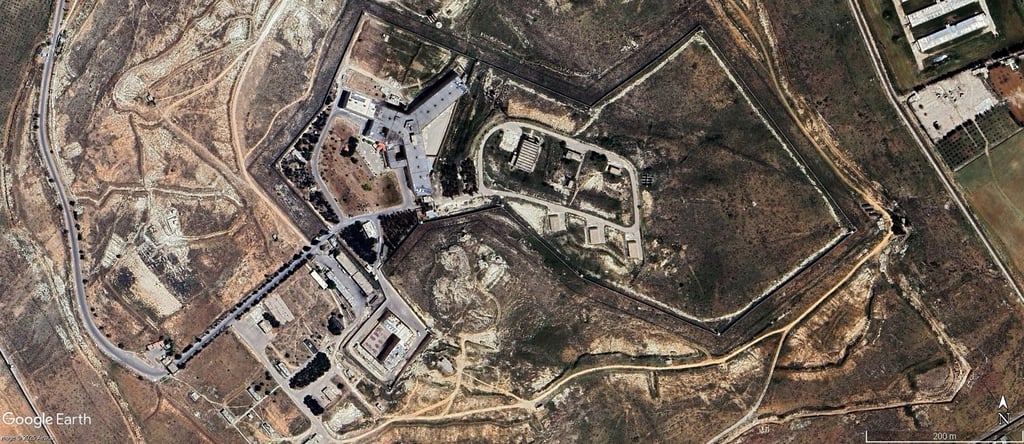
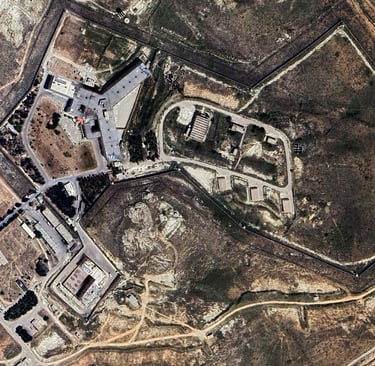
Seydnaya Prison in Syria represents a brutal application of these theories, specifically the Pennsylvania System’s focus on intense isolation. Construction of the facility began in 1981 and was completed in 1986. Located on a rocky hill five kilometers west of the town of Seydnaya, the prison is physically and visually severed from its surroundings.
While aerial photography and visual records are limited, architectural reconstructions—most notably the 2016 study by Forensic Architecture based on the auditory and sensory memories of survivors—have revealed its structure. The prison consists of three rectangular wings connected to a central core in a radial plan (often described as resembling a Mercedes star). This geometric layout features linear corridors and rows of cells designed to allow the administration direct, continuous, and absolute control over the detainee population.
Sensory Deprivation: The Architecture of Silence
Seydnaya is defined by material and visual isolation. The building is dominated by a terrifying silence. Because the detainees' vision is severely restricted—windows are placed high up or obscured with dirty glass to block any view of the outside world—hearing becomes the primary mechanism for survival.
Inmates are forced into absolute silence, a sensory restriction that paradoxically heightens their auditory sensitivity. The soundscape of the prison becomes a map of terror:
Inmates learn to distinguish the sounds of the wind, rain, and water pipes.
The sound of a car approaching the facility signals the arrival of new prisoners.
The sounds of physical violence allows inmates to identify specific torture methods and track whether beatings are confined to one cell or moving sequentially down the row.
The smell of blood becomes a distinct sensory marker.
Visual control is equally sadistic. The steel cell doors are solid except for small openings at floor level. This design restricts the prisoners' field of view to the feet of the guards—specifically their military boots. This is a calculated architectural choice to enforce psychological dominance; the prisoner is always below, seeing only the symbol of the oppressor's power.
Materiality and the "Cold" Environment
The physical construction of Seydnaya actively contributes to the suffering of its inhabitants. The building relies on reinforced concrete, steel, and mosaic tiling. These materials, chosen for durability rather than humanity, create a "cold" atmosphere both literally and metaphorically.
Thermal Cruelty: The building lacks thermal insulation. In the freezing winters of the region, the concrete walls trap the cold, exposing detainees to extreme temperatures that threaten their health.
Psychological Impact: The use of cold colors on walls and floors, combined with the lack of natural light, fosters a depressive environment intended to break the human spirit. The cells are often kept in deliberate darkness, destroying the inmates' perception of time.
Overcrowding exacerbates these conditions. Detainees are held in cells with insufficient space and no privacy, often forced to share toilets that are fully exposed. The combination of isolation, sensory deprivation, and physical discomfort leads to widespread hallucinations and chronic psychological trauma.
Conclusion: From a Site of Torture to a Site of Memory
With the fall of the Assad regime, Seydnaya Prison has ceased to be merely a physical structure; it has become a monumental symbol of the "dark face" of authoritarianism. The penal approach of the regime was rooted in intimidation and humiliation, aiming not to rehabilitate but to reshape both the detainee and the wider society through fear.
Today, as Syria looks to the future, the question of what to do with Seydnaya is paramount. It should not simply be demolished or forgotten. Instead, there is a compelling argument to transform it into a memorial and a center for human rights education. Much like the Tuol Sleng Genocide Museum in Cambodia, Seydnaya can serve as a testament to the atrocities committed. Preserving this space allows future generations to witness the architecture of oppression, ensuring that the victims are honored and that such systematic violations of human dignity are never repeated.