

Sunrise: The Digital Feudalism Project in the Gaza Strip
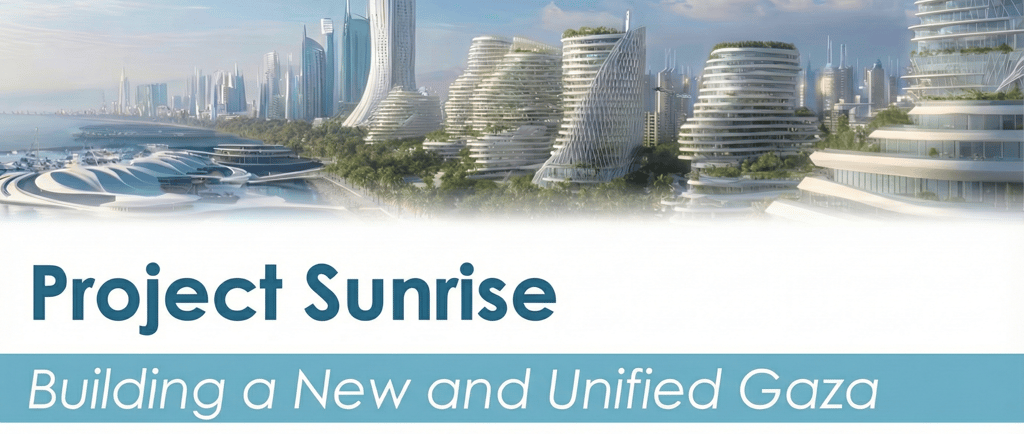
The Sunrise project, unveiled in September 2025 as a centerpiece of a U.S. peace plan, proposes a $112 billion transformation of the Gaza Strip into a high-tech "Middle East Riviera" defined by luxury tourism and glass skyscrapers. However, behind this glossy vision of urban renewal lies a terrifying model of digital feudalism that treats Gaza as a cultural tabula rasa, stripping its residents of their Palestinian identity and political rights. This techno-colonialism replaces traditional state sovereignty with corporate control, where access to basic biological needs -like food- is weaponized through biometric data requirements, and military violence is automated via AI systems.
ARTICLES & REPORTS
Dr. Bilal BİLGİLİ
1/15/2026

Sunrise: The Digital Feudalism Project in the Gaza Strip
In September 2025, U.S. President Donald Trump announced his peace plan to stop the war in the Gaza Strip, aimed at its political reorganization and reconstruction. The plan consisted of twenty items divided into several stages; the agreement between Israel and Hamas on the first stage brought a ceasefire into effect, theoretically stopping the war -at least in principle. This plan followed more than two years of systematic genocide against the Strip, encompassing human, cultural, architectural, and environmental destruction. Gaza, where the most powerful and advanced weaponry was deployed by land and air, stands almost completely destroyed today. The territory served not only as a laboratory for ultra-advanced weapons and a marketing floor for their destructive capabilities, but also as a testing ground for political theories and modernized forms of colonialism.
The Sunrise Vision
The Sunrise project, proposed by Jared Kushner (the U.S. President's son-in-law) and Middle East envoy Steve Witkoff -and promoted by international outlets like The Wall Street Journal last December- is a flagship project for Gaza's reconstruction. It aims to transform the Strip into a luxury tourist destination powered by advanced technology. Under labels like the "Middle East Riviera," U.S. administration visions revolve around turning Gaza into a resort that erases the national identity of Gazans as part of the Palestinian people. Instead, it re-positions them as individuals without rights -foremost the right to self-determination- treating their tragedy as a humanitarian crisis to be managed with oil containers and flour bags. This returns the situation to square one, echoing the aftermath of the 1948 Nakba when displaced Palestinians were treated merely as destitute refugees dependent on international aid.
This article envisions the new system intended for the Strip: a digital feudalism where sovereignty is privatized through reconstruction plans and lives are managed remotely with the click of a button.
Digital Feudalism and Biological Blackmail
Promoted as a glimmer of hope amidst ash and rubble, the Sunrise project is estimated to cost $112 billion, with the U.S. covering 20% of the costs in exchange for significant future financial returns for Washington. The project envisions Gaza as a Smart City with glass skyscrapers and advanced transit networks. Notably, the city of Rafah is designated as the new political and governmental center, signaling a break from Gaza City and its historical past.
However, this project ignores the realities of Israeli occupation and Palestinian sovereignty. It treats Gaza as a white page (tabula rasa), stripped of its historical, social, and cultural layers. By seizing the opportunity created by genocide, it proposes a future city imposed from the outside and cleansed of its local inhabitants.
In this model, the modern nation-state's definition of citizens with rights is replaced. The individual is reduced to data or a user subject to surveillance. Under this digital feudalism, basic biological needs become tools for blackmail. Biometric data and face scans at aid distribution points become a condition for food. Thus, survival is tied to "logging in" to the system, replacing citizenship rights with "user permissions" dictated by system administrators.
Automated Violence and Infrastructure Control
This new colonial model merges technocratic problem-solving with military strategy. AI systems used by the Israeli military, such as Red Wolf and Blue Wolf, analyze field data to generate targets in seconds, effectively outsourcing execution decisions to algorithms. This transforms philosopher Achille Mbembe’s concept of Necropolitics (the politics of death) into a technology-driven automated process.
Furthermore, the project converts Smart City infrastructure into a tool for structural violence. Digitized water and electricity grids can be shut down remotely, allowing the sovereign power to plunge the entire Strip into darkness without a physical siege. This creates a contactless colonialism a smart prison where algorithms replace guards and physical walls become invisible digital boundaries.
Privatization of Sovereignty: Utopia or Dystopia?
The Sunrise model represents the replacement of state sovereignty with global tech corporations and real estate developers. It applies the Charter City logic -previously tested in regions like Honduras and Africa- to Gaza. Reconstruction decisions will not be made by Gazans, but by technocratic elites managing algorithms and capital.
If this form of governance succeeds -where democracy is suspended, sovereignty is privatized, and human rights are turned into user agreements- it could become a blueprint for other conflict zones or authoritarian regimes worldwide.
Ultimately, the struggle over Gaza’s reconstruction is a struggle for property, memory, and human dignity. The Sunrise project violates the "Right to the City" -a concept by Henri Lefebvre- which asserts the right of inhabitants to shape their own urban future. The proposed Smart City utopia is, in reality, a digital dystopia that signals a terrifying future for humanity.
This article originally published in Al-Araby Al-Jadeed Newspaper, January 15, 2026.
Source: The Wall Street Journal